Monday, December 5, 2011

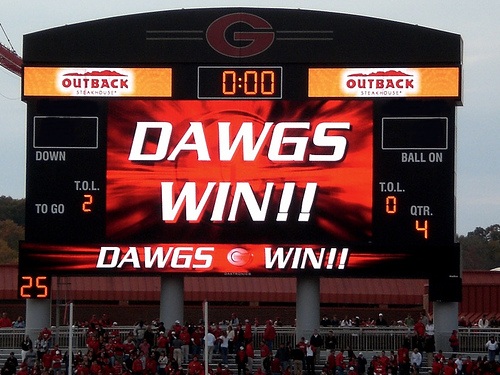
Gone Bowling: University of Georgia vs. Michigan State University


Free Bloomin' Onions for everyone!

by Dub
Throughout the coming weeks, B&A will be going through some of the SEC bowl game match-ups and giving you, the fans, a little bit of background for both the teams playing. I don't know about you, but when bowl season starts, I usually try to catch a little bit of each one, and would like to know a little more about key players on each team, and some of the background of the two teams playing. That being said, let's get started with our first Gone Bowling Match-up: UGA vs MSU.

For our first match-up, we have what look like two very good but not elite football teams. Both are 10-3 and played in their respective conference championship games. The difference between these two teams is that Georgia is the fourth best team in the SEC (first almost anywhere else), and MSU is the second best in the Big 10. What really gets a lot of MSU fans is that Michigan (a 10-2 team that did NOT play in its conference championship game and was beaten head to head by MSU) is going to a BCS bowl, simply for the fact that they did not lose an extra game to Wisconsin.

Georgia is excited to be going to the Outback Bowl, because they have a young team who will likely finish in the top 15 this year, and have a load of returning players, namely Aaron Murray (QB), Isaiah Crowell (RB), and Malcolm Mitchell (WR) who all lead the team in their respective categories. Michigan State is losing both their #1 quarterback and #1 wide receiver, and will likely not be this talented of a football team when Bowl Selection rolls around next December. The point here is that Georgia is a fiery, scrappy team who still has a lot of time left to improve, and is chomping at the bit to get into the bowl, and Michigan State is a team who feels like they were cheated out of "real competition". Now the issue is that when you think the opponent you're facing against isn't up to your level, often times, you let him run right up to you and punch you straight in the face.

Georgia is a team loaded with talent, and the only reason they aren't playing for a BCS bowl is that three other teams in the SEC could all win a national title, playing against anyone else in the nation. This season, Georgia had a front-loaded, painful schedule against two top 12 opponents, which set them back 0-2 right off the bat. They reeled off 10 straight on their way to Atlanta to face eventual SEC Champion LSU. The issue with Georgia isn't the players they have or the schemes they run. The issue is youth, and with youth comes inexperience. LSU was built for the long haul from day 1; when a player went down, another took his place, and played at an All American level. Georgia was decimated by injuries by the time they locked horns with LSU, and it showed.

Michigan State is a team that lost a head scratcher to Notre Dame in September by three scores. Then again, one might look at a schedule from the past couple of years and realize that MSU has lost a game to an unranked opponent early in the season for three out of the last four years. When you don't play in a hyperconference where everyone and their mother is ranked in the top 25, you don't have the strength of wins to be a two loss team and skyrocket through the BCS rankings to play in a big time bowl. Michigan State was blown out by Nebraska by three touchdowns, got it back together, and then lost by a field goal to Big 10 Champion Wisconsin. However, MSU did have big regular season wins over #6 Wisconsin and #11 Michigan. Michigan State doesn't have issues with talent, but with consistency, and unfortunately, they play consistently bad during bowl season against SEC teams.

Now we'll go through and look at three players to look at as these teams meet in January.


Georgia


  • Jarvis Jones #29 LB: His 13.5 sacks are good enough for 2nd in the nation, and he is an absolute monster at disrupting the comfort and poise of the opposing QB. Fast getoff, great balance and technique, and a speed rush that could leave even the best offensive lineman dizzy.
  • Bacarri Rambo #18 S: An absolute ballhawk who rarely let a big play develop. His 7 picks this year are, like Jones, good enough for 2nd in the nation. He's got a nose for the ball, and he takes advantage of QB mistakes.
  • Aaron Murray #11 QB: Passed for 2861 yards and 33 touchdowns, which broke the UGA single season mark of 25 set by Matt Stafford in 2008. Murray is an undersized quarterback who plays a lot like Drew Brees, making up for lack of size in arm strength and timing. Look for him to utilize his tight ends, Charles and Bennett.

Michigan State

  • Kirk Cousins #8 QB: Cousins is as good a quarterback as there is in the Big 10 and holds the MSU career passing touchdown record at 62. He's got good arm strength and good anticipation, which leads to a number of good plays against lazy defenses. Look for him to work the pro sets he has in this game, and to be rolling out of the pocket, as he'll be feeling the pressure of UGA's pass rush. The good news is that he is as deadly on the rollout as he is in the pocket.
  • Denicos Allen #28 LB: This season, Allen has 10 sacks, and plays a similar style to Jarvis Jones, a speed rushing outside linebacker who disrupts the backfield. He is very athletic, and makes plays that force his opponents to account for him on every down. If you want to see how much of a pure athlete he is, go here.
  • BJ Cunningham #3 WR: Cunningham is a big bodied, big play machine. He has 72 catches for 1200+ yards and 12 touchdowns this year, and looks to improve upon those numbers against Georgia's smallish cornerbacks. In order for him and Cousins to have a good game, MSU will need to implement short, quick routes to keep the defense honest and allow the field to open up.
Ultimately, both of these teams are very similar in play style and in ability. Georgia has a bit more of an undersized speedy defense, whereas MSU has a bigger albeit slower defense that relies on sound gap protection to minimize big runs. Both teams are ranked in the top 10 nationally in total defense, and are both top 20 in scoring defense. The series between these two teams is tipped in Georgia's favor, winning 34-27 in the 1989 Gator Bowl and 24-12 in the 2009 Capital One Bowl.

For Georgia to win, they must control the line of scrimmage and force Michigan State to beat them through the air. If one of Georgia's (many) hurt running backs is back for this game, I think UGA wins, propelling themselves into next season with high hopes and a very talented football team.

For Michigan State to win, they must run the ball well against Georgia's very talented front 7. Look for Michigan State to use screen packages and quick pass plays to force Georgia to play off the ball a little bit and give themselves room to run. Michigan State can not win if they cannot establish a run game.

Dub's Prediction: Georgia 37 Michigan State 24


Sunday, December 4, 2011

'11-'12 Bowl Game Schedule

by Arnaldo
Here is a comprehensive bowl schedule that's easy to read and all in one place, for those of you that are like me and hate having to go to ESPN.com every time I want to know when there's a game on and who's playing and have to click on a 8 different places.  Enjoy! (click on picture, right-click and save, so you get the high-resolution version.)


Saturday, December 3, 2011

Xs and Os: The Option


by Arnaldo
If you've watched the Florida Gators play under Urban Meyer, or the Denver Broncos in the last few weeks, you've probably heard the word "option" thrown around a bit.  In this Xs and Os, we're not just gonna define the option, we're gonna get into its specifics, technique, and recent application in the NFL (via Tim Tebow).

The option is nothing more than a series of run plays (from a variety of formations) where there are two or more potential ball carriers.  Conventionally, a run play will have a single predetermined ball carrier running a predetermined route.  The option allows the quarterback to decide during the play, how he wants the ball to be ran.  He does this by reading certain players before the snap, and during the first few moments of the play, and decides how to proceed based on these reads, called "keys".


Option Plays


There are essentially only two option plays that can be executed from various formations.  Each has only two potential ball carriers, or "options".

Read Option

The "mesh" exchange between Tim Tebow and Jeff Demps.
Note Tebow's eyes as he reads his dive key and decides what
to do with the ball.
The first is called a "read" option, which has two possible options, a "dive" track and a "keep" track.  The quarterback takes the snap and puts the ball in the belly of his running back.  Instead of handing it off, he holds it there and follows along with the running back's movement for as long as he can without taking an actual step.  This amount of time is called the "mesh".  During the mesh, the quarterback reads his "dive key", a defensive end (opposite of the running back's direction).  If the end pursues the running back, the quarterback with keep the ball and his keep track will run in a direction away from the dive track.  If the end recognizes the play as an option, and waits to see how the mesh unfolds, the quarterback will hand it off and the play follows the dive track.  Keep in mind that a dive refers to a running route directly up the middle.  If the quarterback reads his key correctly, the offense will always have the upper hand, because the keep track moves away from the end's direction, and the dive track will have a head start on the end who hesitated.  This play is also sometimes referred to as the


Speed Option

Tim Tebow in the motion of pitching the ball on a speed
option run.
The second option play is a "speed" option.  It is so named because as soon as the quarterback receives the ball, he immediately goes into motion.  The two tracks here are the "keep" track and the "pitch" track.  A running back, here refered to as a "pitch back", will be running a few yards beside the quarterback.  When the quaterback (still carrying the ball) runs into some defenders, he may chose to keep the ball, or pitch it back to the running back, based on his read, here called a "pitch key" (usually a linebacker or defensive back).  If the defender pursues the quarterback, he'll pitch the ball, but if the defender follows the pitch man, he'll keep it.  As long as both options aren't being simultaneously covered, the speed option should always get positive yardage.

Triple Option

Josh Johnson running his keep track.
Those two plays are essentially the building blocks of the option.  There are two forms of "triple option" that derive from them.  Triple option meaning that there are three possible ball carriers, the conventional triple option is a combination of both the read option and the speed option.  With two running backs, the play begins and runs exactly like the read option.  If the quarterback decides to keep the ball, he still has the pitch man running beside him (the speed option).  This entire sequence is also known as the "veer" (play; there is also a "veer" formation).

The other triple option is a double speed option.  Innovated (debatable) and perfected (indisputable) by Urban Meyer, this involves all three backs to rush in one direction just like the speed option.  The only difference is that the quarterback has two pitch options, one on either side of him.  The benefit here is that typically on a speed option, the quarterback finds one or two defenders ahead of him, but hardly ever three.  The third option allows allows for positive yardage, almost all the time.  Note that the forward pitch is called a "shovel pass".  This is done to differentiate the two because even a forward pitch is a forward pass.  If it is dropped, the ball is dead as an incomplete pass.  A normal pitch (backwards), if dropped, is a fumble and a live ball.


Formations


Originally, the option was invented out of the single-wing and T formations, but quickly became prevalent out of the wishbone. All three formations are now extinct, so we'll just skip over them.

Flexbone

The most successful flexbone option team.
The wishbone evolved into the flexbone in the '80s where Fisher DeBerry combined the double slot formation with the wishbone option concepts.  The flexbone moved the wishbone's backs into the slot back positions.  This made the overall scheme more pass-friendly, whereas the wishbone wasn't.  This completes the flexbone into a full offensive scheme.  Today, only four FBS teams base their offense off the flexbone option and are considered true option teams.  They are the three service academies, Navy, Army, and Air Force, and Georgia Tech.  If you ever have the chance to closely watch any of these teams play, pay close attention to how the run these plays from the flexbone.  As you can see, the flexbone utilizes four backs, the quarterback, a full back, and two slot backs.  A slot back is a role typically filled with half backs or wide receivers.  The position is a hybrid of the two, and slot backs need to be skilled evenly between the two positions. 

Triple option in the flexbone.  Note the read option that may
become a speed option.
Now lets look at the option plays from the flexbone.  Typically, one of the slot backs goes in motion before the snap, and ends up past the full back by the time of the snap.  The quarterback sidesteps to enter the mesh stage with the full back.  He reads his dive key and makes a decision.  If he decides to keep it, he follows his keep track along side the pitch track ran by the slot back who went into motion before the snap.  After reading his pitch key, he may keep it or pitch it.  This same play can be redrawn in several variations with the tracks slightly moved around.  There is also a lot of room for pass plays and play-action passes from this formation.

Shotgun

Read option from the shotgun (see top picture).
I say shotgun and not spread here because the spread isn't a formation; it's a scheme.  A formation with three or more spread out receivers with the quarterback in the shotgun is considered spread.  Now a shotgun isn't a particular formation either but an umbrella of formations with the quarterback several yards behind the center.  This is the new wave of option football popularized by Urban Meyer, Rich Rodriguez, Chip Kelly and others.  Under this system, the quarterback receives the snap and enters the mesh immediately, or takes off on his track on a speed option, just like before.

Triple option (double speed) from the shotgun.
The difference maker in this system is the spread concept.  Three to five wide receivers spead the defense out and makes wider holes for the option run to find.  This is why under this system, small shifty backs (Chris Rainey, Jeff Demps) are more useful than big, strong, power backs.  The other advantage behind this scheme is that it doesn't become predictable or one sided.  The spread is without a doubt, the best scheme for strong passing.  Look at any two minute offense.  Look at Drew Brees and Aaron Rodgers pass in the spread.  It gives them great field vision, several receivers causing separation in the secondary, and mismatches that will always favor the offense.  Defenses have to prepare for a deceptive option game, and a spread passing, and that's not even factoring what happens when you combine the two for play-action passing.  Defenses can be talented, but unless they're properly disciplined for this type of offense, they'll lose every time.


Reemergence in the NFL


If you're like me, or plenty Gator fans, you've been paying close attention to the Denver Broncos and Tim Tebow.  After going 1-4, the Broncos start Tebow and implement the spread option which has never seen decent play time in the NFL.  As I mentioned earlier, the early option concepts thrived in pro football, but the spread option has never quite made the transition (one exception is the Josh Johnson Buccaneer package).  In my opinion, as reluctant as the NFL has been to change, the players who were a part of the popularization of the spread option are now all in the NFL.  There was bound to be a breaking point.  This isn't to say that all teams will start encorporating the this scheme.  They won't.  There a reason the most popular offensive style is called the Pro-style.  The NFL, like all pro sports, is a business.  A business where people quit their jobs, and get new ones.  Franchise players are a thing of the past.  Free angency, and the need for greed, has homogenized NFL schemes.  Because players and coaches are constantly shifting from team to team, all offenses and defenses styles are basically the same.  There are slight differences and plenty of variations, but they are conceptually the same.  A team that sets out to break these tendencies needs stability so that all their players can adapt to the new system.  It's like moving to a country where they drive on the opposite side of the road.

Yeah, these idiots.
I will say this, however.  There is a reason Tim Tebow excels at these plays.  He is a Heisman winning, two-time National Champion under this system, but as great as that sounds, he's not alone.  There happens to be not one, but two other quarterbacks in the NFL with similar resumes: Vince Young and Cam Newton.  Newton, we all know, won a Heisman and a national championship doing almost exactly what Tim Tebow did a few years prior.  And Tebow succeeded Vince Young, winning a national championship at Texas and coming in second in Heisman voting behind Reggie Bush, who vacated the award (so it's basically his).  They're also not having the most success right now.  Young's future is up in the air.  On the other hand, Cam Newton is having little to no problem fitting into his new scheme, but it still isn't his forte, and the Carolina Panthers still need a jump start.  Don't be surprised if we see Carolina pull a Tim Tebow, and put Newton in a similar option situation next year.

Friday, December 2, 2011

Conference Realignment: What It Means for the SEC and Florida

by Arnaldo
A conference is like a party.  You go where your friends go, that is after all, the whole point of the party, being with your friends.  If one person wants to leave to go to another party, chances are, they'll take someone with them.  Two less people there give a third person less reason to be there instead of another party.  A chain reaction ensues and before you know it, said party is over and the keg is still full.  Now I don't know what the keg is in this metaphor but the rest should be pretty clear, and that's exactly what's been happening the last year of college football.


But how does it affect us?


First of all, it really shouldn't.  The SEC scheduling looks like this (as of before the realignment): there are 12 teams and 2 divisions.  Each school plays the five other divisional schools, one permanent school from the other division, and two rotating home-away basis schools from the other division.  The four remaining games are out of division and up to the school itself to schedule.  I say this because intraconference scheduling is up to the conferences and not the NCAA.  Each conference schedules differently.  The Pac-12 plays a 9 game conference schedule with 12 teams.

So does this mean the SEC needs to move to a 9 game conference schedule?  Not necessarily, but it isn't a bad idea.  The problem here is that removing one of those slots removes the SEC's much needed "padded match-ups".  Coaches will tell you they need these games, especially in the beginning of the season.  The SEC is obviously the toughest conference in the NCAA; that's no longer a point of contention.  Each match-up has the potential to be unforgiving and disastrous.

We have to contrast this to the problem with keeping an 8 game conference schedule.  With one more team in each division (Texas A&M to the west and Missouri to the east [sure, moving Auburn to the east was rumored and makes more sense, but that's just making too many waves]), one interdivisional game has to go.  Schools and fans will not allow the permanent match-up to dissolve.  Florida would lose playing LSU every year, and Deep South's Oldest Rivalry (Auburn-Georgia) would need a new name, or actually no name at all.  The SEC, however, will probably prefer this option so that there is more complete competition.

Trust me, we NEED this game.
Either way, the media loves to pretend these things are already decided and that all rivalries will cease to exist starting next year, but they're just plain wrong.  The worst case scenario involves some teams losing secondary or tertiary rivalries, which is a loss, don't get me wrong.  When the SEC was last expanded in 1992, Florida and Miami had to stop meeting up yearly.  Miami's rivalry with Florida State held together because Miami moved from the Big East to the ACC in 2004, FSU's conference.  The teams that suffer the most are the teams actually moving, and they elected to move in the first place.  Texas A&M will most likely keep their rivalry with Texas in the same way Florida plays Florida State every year even though they're in separate conferences.  They will lose yearly match-ups with Texas Tech and Baylor, but coincidentally, the Aggies are rivals with Arkansas and LSU and total over 60 match-ups with each.  Obviously they'll be awarded those rivalries back.  In the same fashion, Missouri should keep their Border War with Kansas but lose their rivalries with Oklahoma and Illinois.  Their rivalry with Nebraska already dissolved when The Cornhuskers moved to the Big 10.  Hopefully, Mizzou will develop another Border War with Arkansas in the upcoming seasons.


Where do we go from here?


But we JUST made this cool new logo.
The SEC looks pretty comfortable with 14 teams; let's hope the superconference trend ends there.  I say this because larger conferences only complicate things.  Think about it, if conferences get bigger, more divisions will be formed, more rivalries lost, and there will be a larger pool of teams from which to play all around.  The end result is a copy of the NFL, where there are no real rivalries and nobody remembers which conference they're in, because the conferences mean nothing, only the divisions do.

However, I see no problem with the constant changing of conferences for teams scattered around the map; not only is it happening now, it's been happening for years.  This holds with me as long as the party scenario doesn't happen again.  Conferences were already nicely set geographically across the map, rivalries were well established, and scheduling was simple.  The sad news is that despite adding TCU and West Virginia, the Big 12 is still not stable.  Less stable than them is the Big East.  Losing their BCS automatic qualification is looking inevitable, and hopefully this may make them less desperate to add more significant teams and help them to stabilize.

What's most important to remember is the SEC is looking indestructable. Five consecutive national championships (six soon), the addition of two teams that should be growing back to prominence (new management at Texas A&M with an SEC budget should help), and a sweet TV deal with CBS that should (God willing) be opting for an ESPN upgrade in the near future makes the SEC party look like New Years at the Playboy Mansion.

This actually looks kind of awesome.

Thursday, December 1, 2011

3 Football Concepts You've Probably Never Heard Of


by Arnaldo
Football is an ever-evolving sport.  And for every undiscovered play, formation, or scheme, there's one that's as archaic as it is forgotten.  The best part is that some are so old, not only would they never fit in today's game, they're kind of hilarious to think about.

The Drop Kick

Close, but not quite.
What is it?

Sounds like a punt, or a some sort of kick to the face, but the drop kick was originally borrowed from rugby where the ball was allowed to bounce off the ground first and then kicked for field goal tries.  Sounds retarded but at the time only place kicks were restricted to behind the line of scrimmage.  You could advance the ball, and then drop kick it for a field goal all in one play.  Again that probably sounds retarded but when the clock is already expired or the ball carrier is about to be tackled before the first down marker on a failed fourth down attempt, it's a last second scoring (or punting-ish) opportunity.

What killed it?

Two particular changes to the game.  The first being the shape of the ball itself, which in 1934 took its current shape.  Before this they resembled the modern rugby ball with a predictable bounce.  If you've ever even played catch with a modern football, you know once it hits the ground, there's no telling where it's coming back.  The other was a rule change which prohibited any sort of kicking passed the line of scrimmage.  So if your options are to risk a bounce or to kick it with a place holder, you're gonna go with the place holder.

Unless your holder is Lucy
The drop kick could still be used as a surprise tactic.  It may be risky but a fourth down defense will never be able to block a field goal.  Then again field goals aren't typically blocked, they're missed, but hey, that's why it's a dead play.

Its dying day:

The drop kick was dead in 1941, two weeks after the bombing of Pearl Harbor when Ray "Scooter" McLean used it to score a field goal for the Chicago Bears in their NFL Championship Game victory over the New York Giants.  It was however, revived (kind of) in 2006 by Doug Flutie and the Patriots.  In the last regular season game over Miami, the Patriots were satisfied with their seeding and had the backup quarterback drop kick for a field goal in the last seconds of play.  It was more a tribute and a novelty for Flutie's last game.  What it did best though, was confuse the sh*t out of Nick Saban.  "It sort of screwed me up," as he took a time-out, "I couldn't figure out what was going on.  They had a quarterback in, four tight ends and a receiver and there was no kicker.  I was kind of pleased to know that somebody can still drop kick.  Man, when I was a kid we all practiced that.  Thought it was a lost art, but you know Flutie showed his age on that one."


The Singlewing Formation

What is it?

One of the oldest offensive formations in the books invented by Pop Warner at Carlisle with Jim Thorpe.  With a modern perspective, this formation really looks like a pile of nonsense.  It involved an unbalanced line with the quarterback no where near center.  The quarterback lines up behind the right tackle and the tailback would receive the snap.  It was later tweaked by Knute Rockne into the "Notre Dame Box" which added presnap motions and passing opportunities.

We'll just call this UF-FSU 1921

What killed it?

Glenn Scobey "Pop" Warner
The evolution of football to a faster-paced throwing game saw less room for such one-sided schemes.  The T formation began to take over, which had a more balanced approach to passing and running, and introduced option runs. The Pittsburg Steelers were the last to use it has their standard formation in 1952.

It's dying day:

I realize I just said when the single wing died, but the truth is that it's not dead at all.  If you know anything about the wildcat you should've been yelling it out loud when reading about the single wing.  Though not exactly the same, the wildcat does borrow its run first philosophy and replaces the quarterback with a tailback

The Quick Kick

What is it?

The quick kick is by far the most pathetic play in football.  Or at least it's early incarnation is.  Any punt which is done outside the normal punting circumstances is a quick kick.  Simply put, the quick kick is punting on a down other than fourth.  Strategically, it's a way to back up the opponent by punting to no returner, at the cost of another down.  It's admitting defeat on offense and digging at the bones for a few more defensive yards.

What killed it?

Yeah, we're just gonna punt it now...
Wouldn't want you to throw another interception.
It's just a bad idea, that's what.  At no point should you abandon hope on offense, and no amount of punt yards justifies the loss of another attempt on offense.  Because of this, the quick kick was never a popular strategy, and it's most common application occured when teams were winning by a good margin and feared running up the score.

It's dying day:

Again, the quick kick isn't completely dead.  It was instead redefined to any punt outside of normal punt formations regardless of down.  Under this definition the quick kick is actually fairly popular as a trick play.  The coach sends out their offense on 4th and short and the defense prepares for quick pass or loads the box, the quarterback takes the snap and punts the ball.  The safeties are nowhere near the punted ball and the receivers arrive first to ensure a favorable roll.

Wednesday, November 30, 2011

Xs and Os: Defensive and Special Teams Positions


by Arnaldo
Obviously after covering offensive positions, defensive and special positions were to follow.  A lot of these positions vary depending on the defensive scheme but we'll get into that later.  For now we'll just assume a standard 4-3 defense.

Defensive Positions

Defenses have three levels, the defensive line, linebackers, and the secondary.  I realize the secondary is the third level of the defense, but the name comes from the term "the box" which combines the d-line and the linebackers making the secondary the second line of defense.  Keep in mind that the rules allow defensive players to move freely and line up anywhere on their side of the line of scrimmage, so where I say these players line up may change during an actual game but they will usually line up there.

Defensive Tackles and Ends.  The defensive line consists of these.  The term "tackle" refers to the offensive tackles, if not the act of tackling, so the defensive position is usually referred to as a defensive tackle.  The defensive line has one job: tackle whoever has the ball.  On pass plays they are trying to penetrate the pocket to tackle the quarterback (a sack).  On run plays they are still trying to penetrate the offensive line to reach the ball carrier.  How they do this does vary depending on the particular play.  Defensive tackles line up in a 3-point-stance on either side of (and facing) the center and usually try to penetrate the A-gap, the gap between the center and either guard.  In a 3-4 scheme, or any time a defensive tackle lines up directly in front of the center, he is referred to as the nose tackle.  Defensive tackles are usually the biggest players on the team weighing in between 300-370 pounds. 

Defensive ends line up other outside the defensive tackles also in a 3-point-stance.  They push the tackles while also trying to get around them using their speed.  Defensive ends are usually smaller and quicker and there's a recent trend that is making them even smaller.  The days of 290 pound ends are approaching their end.  Now, most teams (especially in 4-3 schemes) use 250-275 pound ends that are quicker to get around the tackle to make a sack, and can still drop back into coverage on specialized plays (see Jarvis Moss, Derrick Harvey).

Linebackers.  The second level of defense are linebackers who line up, stay with me here, behind the d-line.  Their roles are typically more complex than that of the linemen.  In man coverage they are assigned an offensive skill player to cover, while in zone they have a tight zone to cover.  They're also the most common blitzers (whoever rushes the quarterback besides the d-line).   There are usually 3 linebackers on the field, two outside linebackers and a middle linebacker.  They also have nicknames to distinguish which linebacker they are.  The middle linebacker is referred to as Mike, the strong side linebacker is Sam, and the weak side linebacker is Will.  The strong side of the field is determined by which side of the offensive line the tight end line up , the opposite side is the weak side.  More times than not, the right side (from the offensive's perspective) is the strong side.  Furthermore, if the tight end goes in motion to the opposite side, the defensive assignments may shift over so that Sam doesn't have to move with him, unless that particular match-up is critical for the defense.  Linebackers are typically lean but very well built.  They are usually around 245-270 pounds.  The middle linebacker is typically largest of the three but doesn't necessarily need to be.

Cornerback.  The cornerbacks along with safeties make up the secondary.  Cornerbacks line up one on one against the X and Z receivers, in most schemes.  They must be among the fastest players on the team to keep up with the receivers.  Cornerbacks are not only responsible for not letting his assignment get into open space, if a pass comes his way he has to put himself between the ball and the receiver without interfering on the receivers ability to catch the ball (this would result in a pass interference call), and if he can, make an interception.  Cornerbacks are sometimes called on to blitz.  Because of their angle towards the quarterback, they often sneak up on him, so much so that former quarterback coach and head coach Jon Gruden calls them corner cats (see Ronde Barber, Darrelle Revis).

Safeties.  Safeties come in two varieties and there are usually only two on the field: strong safeties and free safties.  Strong safeties are usually stronger but the name derives from strong side, where the strong safety lines up behind the Sam linebacker (see Ahmad Black, John Lynch).  Free safeties line up loosely behind the strong safety but on the weak side of the field.  They typically are a bit quicker than strong safeties.  Safeties in general sit back and wait to see the play unfold before engaging.   If the play develops into a run, the safeties will engage to assist on the tackle from the "north" (the direction the offense is facing) so that in case the ball carrier escapes a few tackles, the safety is prepared to make the last possible tackle.  Safeties are taught to never find themselves behind the offense, but different coverage schemes might have them on unusual parts of the field and certain blitz schemes might utilize safeties as pass rushers.

Special Teams Positions

A football team usually has 5 special teams.  It could have fewer depending on how the personnel carry over, but there are 5 different needs for a special team: kick-offs, kick returns, punts, punt returns, and onside kicking/receiving (hands teams).  Field goals typically use the same team that handles punts but with a kicker instead of a punter, and a holder.  The majority of each special team is made up of starters and back-ups of various positions with the addition of a few specialized roles and a few specialized positions.

Let me begin by differentiating a role and a position.  A position is the type of  player who handles certain responsibilities.  A role is a job that could be filled by a certain position or various positions.  A quarterback is a position, the starting quarterback is a role. 

photo: photo-gator (Flickr)
Kicker.  The kicker handles the kick-off and field goal kicking.  A kicker's experience probably includes punting, but the two positions are specialized, so there is a designated kicker and punter.  Keep in mind punting involves receiving the snapped ball, dropping it and kicking, while kicking refers to kicking the ball from a tee or by a live place holder.

Punter.  Already kind of defined above, a punter is called upon on 4th down situations to strategically giving up a down to move the ball as far back as possible for the other offense to use.  In the event of a safety, a punt by the nonscoring team is required to return the ball back to the scoring team's offense from the 20 yard line, though a tee-less kick or a drop kick is also allowed.  College rules now allow a team to kick off the ball with a tee from the 20 instead.  Punters and kickers have no size significance.  Their skills lie solely on their abilities to kick, so usually they may vary in height but are usually very skinny.

photo: photo-gator (Flickr)
Long snapper.  The long snapper is a specialized position.  On punts and field goal tries, he will line up at center, and snap the ball back to the punter or holder.  This requires him to be a much more precise snapper than the starting center.  The long snapper also needs to see his snap for precision while a center snaps while facing forward.


Holder. The holder is a role.  It's usually filled by a punter or occasionally a backup quarterback.  On field goal attempts they catch the football from long snapper and quickly set it up to be kicked.

Punt/kick returner.  These are also roles filled usually by the fastest shiftiest player, typically a wide receiver, running back, or defensive back.  There is usually a separate punt returner than kick returner.  Some kickoff formations have two possible returners on both sides of the field.  Returners need to be fast, but the ability to read blocks down field, escape tackles, and make quick cuts and jukes are probably just, if not more, important than pure speed.

Xs and Os: Recognizing Penalties: Episode 1


by Dub
The stadium is roaring. The other team is on offense on its own 20 and just ran a deep pass play on 3rd and 10. Forty yards down the field lies a yellow penalty flag. Your team’s number one corner back is walking back to the defensive huddle shaking his head and trying to speak to the referee. He throws his hands up in frustration and the referee queues his mic to let us all know, “Pass interference, Defense, Number 31, Automatic first down”. The crowd erupts, as a fan next to you is screaming and trying to get a “BULLSH*T” chant started among the others. You feel lost, not knowing what just transpired on the field, and you want to know how to avoid it for next time.
We here at Bruce and Albert know that watching football with your friends can be a little intimidating. No one wants to stand up and scream at the television, cheering and high-fiving his friends, or to rally the marching band to play the penalty song, only to find out the penalty is against your own team. This is our first installment of Xs and Os: Recognizing penalties. 

The first set of penalties we will discuss is one that hits rather close to home for us Gators & Buccaneers fans: interference calls on receivers and defensive players. There are a number of calls that can be made down field that could either negatively or positively influence your team's success. For all of our rules discussions, we will be using the 2011 Official Playing Rules and Casebook of the National Football League which can be found here.

I could just tell you what the penalties are, and have you look them up, but we'll explain here with some photos to better detail the rules. The most often called penalty down field is Defensive pass interference, often referred to among football geeks as "PI". As a precursor to all of this verbiage, though, we want to make very clear that none of these penalties will ever be called, NCAA or NFL, if the defensive or offensive player is watching the ball and making a play without looking back at the other player. This will be explained later.

As defined by the National Football League in Rule 8 Section 5 Article 1, "It is pass interference by either team when any act by a player more than one yard beyond the line of scrimmage significantly hinders the progress of an eligible receiver’s opportunity to catch the ball. Pass interference can only occur when a forward pass is thrown from behind the line of scrimmage, regardless of whether the pass is legal or illegal, or whether it crosses the line". In short terms, Defensive PI occurs when the quarterback (or whoever is acting as the passer) throws the football to a receiver, and the defensive player makes contact to prevent the receiver from making a catch, before the ball arrives (see figure to the left). Offensive PI is the same, but the roles are switched; it occurs when a receiver is going down field and realizes he cannot make a play on the ball, so he keeps a defensive player from catching the ball through contact, which is defined as any touching between two players after the ball has left the hand of the quarterback, but before arriving at a catchable point for either player. These are usually tactics used by players when playing very aggressive coverage, or if there is possibility of the receiver or defensive player making a game changing play on the ball, like a touchdown or interception as the case may be. As a side note, contact down field between a defensive player and receiver to prevent making a catch is called Illegal Contact, if the ball has not left the hand of the quarterback. The distinction between the two is easy to remember, if the ball is thrown its interference, and if it’s not, it’s illegal contact.

While penalties are usually a sign of an undisciplined football team, pass interference is not always a bad thing. Now we’re going to talk about situational pass interference using some names you might know. Florida is playing against Tennessee, and Florida is on offense. John Brantley receives a snap and looks down field for Andre Debose. He throws the ball down field where Andre and a corner back are sprinting toward the end zone (for all intents and purposes this corner back will be referred to as CB). The ball is in the air, arching down toward the two players racing to make a game changing play. Debose jumps into the air to make a catch, but jumps too early, realizing he may have misjudged the ball. He realizes that, not only is he not going to catch the ball, but CB who ran slightly slower than Debose is closer to the ball and  looks to make a clean interception, and possible return. Mid-air, Debose grabs the defensive player and wraps his arms around him, dragging him to the ground, preventing CB from making the play. You know, though, that this will not result in a turnover, and instead just be a penalty. As a football team, you ALWAYS want to prevent a score, at whatever cost.

The other kind of down field “interference” penalty is Defensive Holding. Defensive Holding is defined in the NFL rulebook Rule 8 Section 4 Article 6“… defensive holding if a player grasps an eligible offensive player (or his  jersey) with his hands, or extends an arm or arms to cut off or encircle him”. This occurs when a receiver is running down field and a part of his body or uniform is held by a defensive player, who is trying to prevent him from making a play. This call is also very easy to understand, when you have the right signs. A player might be running slower than normal, or look hindered; this is a situation when you check the defensive player’s hands during the play and see if he is grasping any material or part of the other player. This is a call that, like pass interference, can be made to prevent a big scoring play. However, sometimes both of these plays are made by a defensive player who realizes he is beaten and is just making a last ditch effort to disrupt the play.

As we stated in our precursor, none of these plays will be called penalties if a player is “playing the ball” not “playing the man”. Here is a very quick explanation. Imagine two players standing on the goal line. We’ll use Andre Debose and CB again as our examples. Debose and CB are looking back downfield toward where John Brantley is standing and has thrown the ball. As the ball approaches the two players on its downward arc, Debose and CB bend at their knees and prepare to jump. Debose is in front (closer to John Brantley than the end zone), and uses hand to stabilize himself on the other player as he is in the process of jumping. They both jump and Debose makes the catch, immediately being tackled by CB. This is what is known as Incidental Contact, and will be a “no call” every time. The reason it is not called is because Debose is making a play on the ball without vastly changing the outcome of the play. While it may give him a slight edge, as long as he is looking at the ball and not making an obvious effort to give himself an advantage, he won’t get flagged.

Hopefully, now you will be able to watch a football game and know not only the penalties being called, but how to quickly recognize them, and whether or not they were situationally advantageous for your team. If you have any questions, please comment on this post and we’ll respond as soon as possible!